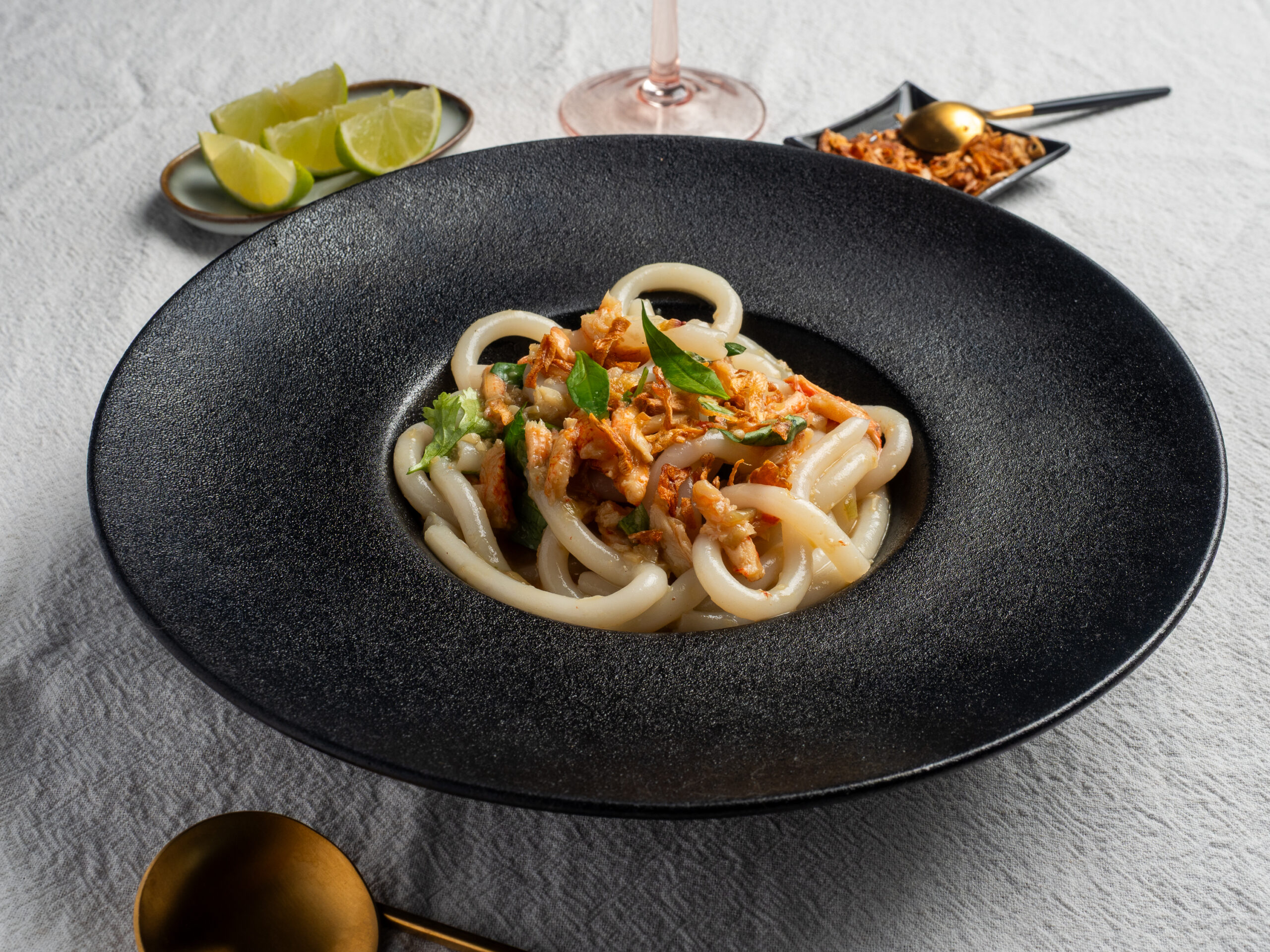
Vietnamese Thick Rice Noodles with Crab Sauce
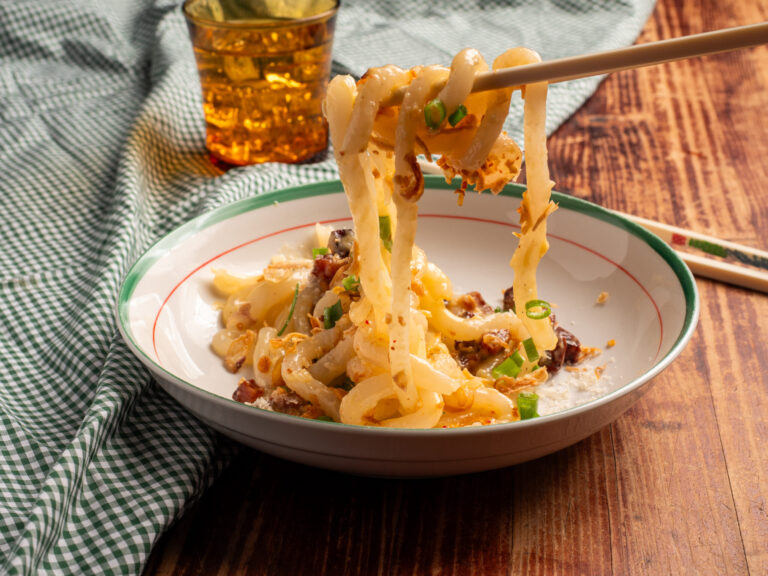
I grew up eating Bánh Canh as a soup. This isn’t that. Same Vietnamese thick rice noodles with crab sauce foundation – annatto-stained prawn stock, fresh-piped noodles – but pulled back until it coats rather than pools. A version I made up. I reckon it’s just as good.
You can find these noodles at Vietnamese grocery stores, but this recipe also works if you can’t. Don’t substitute udon – it’s not the same thing.
Vietnamese Thick Rice Noodles with Crab Sauce
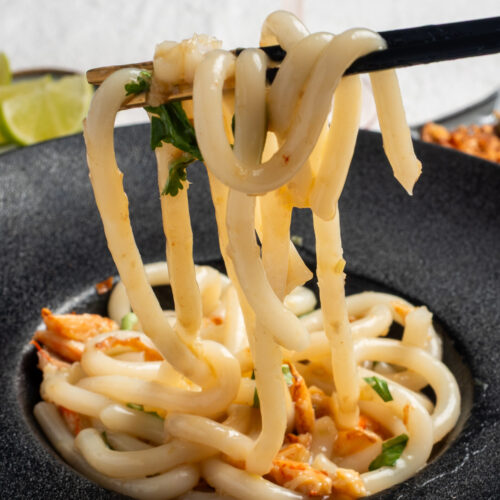
Vietnamese Thick Rice Noodles with Crab Sauce (Bánh canh sốt cua) is a bowl of hand-piped thick rice noodles tossed in a glossy, annatto-tinted crab and prawn sauce. The noodles are made fresh from a hot rice and tapioca paste, piped directly into boiling water – a technique that takes a couple of attempts to read correctly, but delivers a texture no dried noodle can match.
Equipment
- 1 stand mixer with paddle attachment
- 1 large pot for boiling noodles
- 1 medium saucepan for prawn shell stock
- 1 medium saucepan for crab sauce
- 1 fine-mesh sieve
- 1 spider or slotted spoon
- 1 disposable piping bag
- 1 pair of scissors for cutting tip of piping bag
Ingredients
Bánh Canh Noodles
- 240 g rice flour
- 160 g tapioca starch
- 4 g fine salt
- 450 g boiling water freshly boiled, streamed in while mixing
- 50 g boiling water freshly boiled, held back – add if paste is too stiff to pipe
- 20 g boiling water freshly boiled, held back as a second reserve – use only if paste still feels too firm after the first addition
- 20 g neutral oil
Prawn Shell Stock
- 250 g prawn shells thawed if frozen
- 15 g neutral oil
- 20 g shallot sliced
- 10 g garlic crushed
- 750 g water
- 2 g fine salt
Glossy Crab Sauce
- 30 g neutral oil
- 8 g annatto seeds
- 30 g shallot finely diced
- 15 g garlic finely chopped
- 180 g crab meat thawed and well drained
- 350 g prawn shell stock hot, measured from the batch above
- 18 g fish sauce
- 2 tsp oyster sauce
- 1 tsp caster sugar
- 1 g ground white pepper
- 2 tsp tapioca starch mixed together with cold water as a slurry before adding
- 20 g cold water
To Finish
- 20 g fried shallots
- 10 g coriander leaves leaves picked
- 8 g Vietnamese mint rau răm leaves
- 1 lime cut into wedges
- 2 g ground white pepper
Instructions
Prep
- Thaw the frozen crab meat and prawn shells in the fridge overnight if frozen.
- Place the crab meat in a sieve over a bowl and drain while you make the stock, patting it dry if it looks very wet.
- Pick the coriander and Vietnamese mint (rau răm) leaves, slice the chilli, and cut the lime into wedges.
- Measure all noodle ingredients and keep the disposable piping bag and scissors ready, but do not make the noodle paste yet.
Prawn Shell Stock
- Heat the neutral oil in a medium saucepan over medium-high heat.
- Add the prawn shells and cook for 3 to 5 minutes, stirring often, until fragrant and orange.
- Add the shallot and garlic and cook for 1 minute until aromatic.
- Add the water and fine salt, bring to a boil, then reduce to a steady simmer and cook for 25 minutes.
- Strain through a fine sieve, pressing firmly on the shells to extract as much liquid as possible.
- Measure out 350g hot stock for the sauce and keep any extra stock hot in case the sauce needs loosening later.
Crab Sauce Base
- Heat the neutral oil and annatto seeds in a wide pan over medium-low heat for 2 to 3 minutes, until the oil turns deep orange.
- Strain out and discard the annatto seeds, then return the infused oil to the pan.
- Add the shallot and cook for 2 to 3 minutes until softened, then add the garlic and cook for 30 seconds.
- Add the 350g hot prawn shell stock, fish sauce, oyster sauce, caster sugar, and white pepper, and bring to a gentle simmer.
- Mix the tapioca starch and cold water in a small bowl until smooth.
- Stir half the slurry into the sauce and simmer for 30 seconds – the sauce should look glossy but still loose, so add more slurry only if it looks watery.
- Turn the heat to low and keep the sauce base warm, holding off on the crab until the noodles are ready.
Do not let the seeds burn – burnt annatto turns bitter.
Bánh Canh Noodles
- Bring a large pot of water to a gentle boil.
- Add the rice flour, tapioca starch, and fine salt to the stand mixer bowl and mix briefly on low to combine.
- With the mixer running on low, stream the 450g freshly boiled water down the side of the bowl and mix until the flour hydrates into a hot, thick, sticky paste.
- Increase to medium speed and mix for 5 to 6 minutes, scraping the bowl once or twice, until the paste looks smoother and more elastic.
- Cover the bowl and rest the paste for 10 minutes – it should relax slightly and become easier to pipe.
- Check the texture while still warm: it should be thick, sticky, and pipeable, holding soft ridges that slowly slump back.
- If the paste feels too stiff to pipe, mix in the held-back boiling water 10g at a time on low speed, using up to 50g first, then the additional 20g only if needed.
- Load the warm paste into the disposable piping bag, twist the top tightly, and cut a hole 5mm to 6mm wide at the tip.
- Pipe the paste directly into the gently boiling water, cutting the strands with scissors every 10cm to 12cm, working steadily without overcrowding the pot.
- Cook for 3 to 5 minutes, or until the noodles float and look slightly translucent around the edges.
- Lift the noodles out with a spider or slotted spoon and rinse briefly in warm water to remove excess surface starch.
- Toss with a few drops of neutral oil only if the noodles need to sit for more than 5 minutes before serving.
Assembly
- Return the sauce base to a gentle simmer.
- Gently fold in 120g of the crab meat and warm for 30 to 45 seconds, keeping the remaining 60g aside for topping.
- Add the warm bánh canh noodles to the sauce and toss gently for 30 to 60 seconds until coated and glossy, loosening with extra hot prawn shell stock 20g at a time if the sauce tightens too much.
- Transfer to bowls and top with the reserved crab meat, fried shallots, coriander, rau răm, sliced chilli, white pepper, lime wedges, and a small spoon of chilli oil or annatto oil.
Notes
Storage
- Best eaten immediately – the noodles absorb the sauce quickly and will thicken it further as they sit.
- Leftover noodles and sauce can be stored separately in the fridge for up to 2 days; loosen the sauce with hot prawn stock when reheating.
Key pitfalls:
- Make the sauce base before the noodles – once the noodles are cooked, they need to go straight into the sauce
- The sauce must look slightly too loose before the noodles go in, because the noodle starch will tighten it quickly
- Do not add the crab meat too early – it only needs 30 to 45 seconds of gentle warming so it stays sweet and doesn’t disappear into the sauce
- Do not leave the cooked noodles sitting dry – they will clump fast, especially without oil
- Do not let the annatto seeds colour aggressively over high heat – burnt seeds turn the oil bitter
- Keep extra hot prawn shell stock nearby throughout service so you can loosen the sauce if it seizes